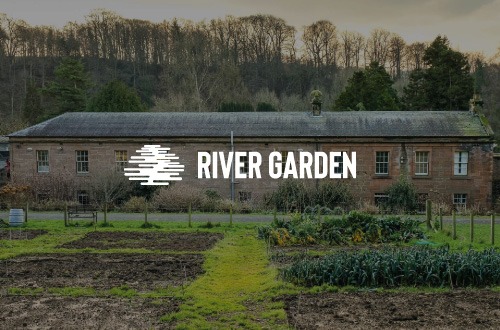
IFDAS is a registered charity that is a part of the Scottish Government’s National Mission to reduce the country’s unacceptable drug death rates. As part of that mission, IFDAS set up the River Garden project at the Auchincruive country estate in Ayrshire.
Introduction
Client: Independence from Drugs and Alcohol Scotland (IFDAS)
Duration: Phase 1, five months. Phase 2, three months.
Value: Phase 1 was carried out ex gratia
River Garden Auchincruive (LGA) runs a three-year residential programme designed to help the recovery, rehabilitation and reintegration into society of those with drug and alcohol dependences. Living on-site, residents are given the means to grow and flourish through peer support and participation in social enterprises. Monitored throughout the programme, residents learn trades and skills, such as gardening and cooking, which can be used once back in society. At River Garden, they have a better quality of life and can be joined by visiting friends and family who stay in their own on-site block.
Overview
Sigma was commissioned to carry out the transformation of the bothy following a meeting with the RGA’s architects, Glasgow-based, G1 Architects. The work was to be carried out in two phases, with the residential housing block conversion taking place first and the visitor accommodation commencing once the resident housing was completed.
While funding was secured from the Scottish government, Sigma, as part of its corporate social responsibility (CSR) commitment, agreed to undertake the work on phase one ex gratia.
The Challenge
The work at RGA presented a number of challenges to Sigma, not least of which was that this was a completely different type of project to what the company is used to. Primarily, Sigma carries out construction and refits for large retail organisations, often working across multiple stores and warehouses in urban areas. The transformation of a dilapidated, listed building in the Scottish countryside was an out-of-the-ordinary experience that presented some unexpected hurdles, including:
- The restrictions of working with listed building
- Delays due to the protection of bats.
Phase 1
Phase 1 of the project was to create accommodation for three residents to live in the bothy. The accommodation was to comprise three rooms, plus a kitchen and shower rooms. Work was set to commence in October 2021 and scheduled for completion six weeks later.
During a survey of the property, however, it was discovered that bats had been living in the roof of the bothy for some time. As a protected species, a chiropterologist was brought in to deal with the issue before work could commence and this delayed the start of the project.
Once the bat issue was successfully resolved, the state of dilapidation at the bothy meant that it needed completely gutting out and taking back to a blank canvas before it could be repurposed as modern living accommodation. Completing this part of the project and ensuring that the work was in line with listed building regulations, took a further four weeks. As a result, phase 1 was completed in March 2022, some eight weeks behind schedule.
Phase 2
Phase 2 of the project was to create visiting accommodation for the friends and family of those living in the Phase 1 rooms. Again, this part of the building needed to be completely gutted before the new rooms could be built. Work commenced at the end of April 2022 and is due for completion at the end of July 2022.
The Sigma Approach
While River Garden was anything but normal for Sigma, the company still brought its usual collaborative approach to the project. It worked closely with all stakeholders, including IFDAS, G1 Architects, local planning and building regulation officers, and as the building was listed, Historic Environment Scotland. This approach ensured that all parties were fully informed of the work that was being carried out and of the obstacles, like bats, which impacted the project.
Aside from its contractors carrying out the gutting and redevelopment work at the site, Sigma also took responsibility for the mechanical and technical aspects. This included ensuring that machinery, equipment and materials were procured and delivered on-site at the right time for the contractors to use, and that waste materials were responsibly disposed of.
With the Bothy Café being open during the project and this being a vital part of the residents’ rehabilitation and an important source of income for the charity, Sigma ensured that its operations caused minimal disruption.
Outcome
Phase 1 of the project has now been successfully completed and phase 2 is coming to an end. The work carried out during both phases is in line with planning and building regulations, including those for listed buildings. As a result, RGA can now offer support to a wider number of those in need, with residents living in accommodation that is comfortable and fit for purpose, but which maintains its integrity as a historical, listed building.
Overall, RGA is extremely happy with the quality of the work carried out, while Sigma is proud to have contributed to such a worthy project that is having a transformational effect on people’s lives.