
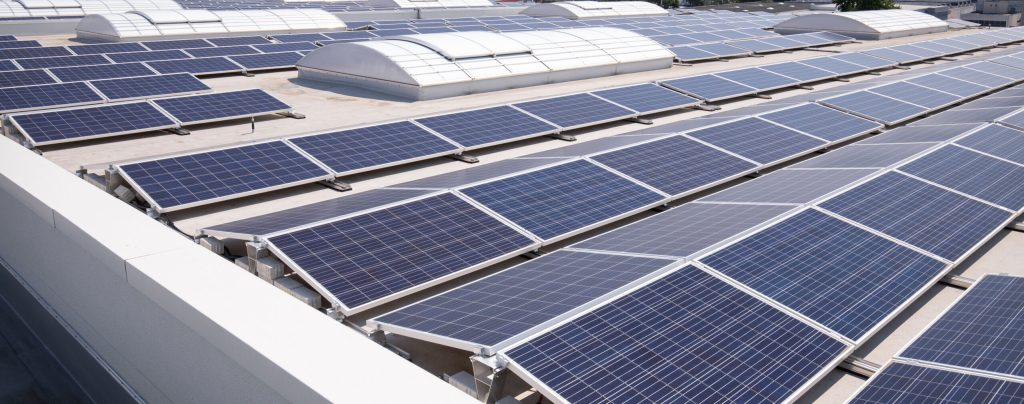
Businesses have been using solar energy solutions since the mid-1970’s oil crisis. Today, with 50 years of development behind them, they have become a proven and reliable source of energy that can cut energy costs, generate income and help with environmental regulatory compliance. Moreover, they can enhance brand image and fortify energy security. Here are the top five reasons businesses should invest in Solar PV.
Energy Cost Savings
The rising cost of energy has become a financial burden for businesses over recent years, forcing many companies to seek to minimise consumption or find alternative energy sources. Solar PV, which converts sunlight into electricity and stores it in batteries for later use, is one of the most popular and reliable alternatives available.
Moreover, advances in the technology mean photovoltaic cells are cheaper to produce and generate electricity more effectively; batteries can store more electricity; and modern inverters provide safer and more reliable single-phase or three-phase power to buildings. The latest Solar PV solutions also integrate with other building control systems and have intelligent battery management features.
In terms of energy savings, a Solar PV system can supply a substantial amount of a company’s energy requirements, potentially saving millions of pounds in energy costs over a 25-year period. Given that the average payback period for a commercial Solar PV system is 3-4 years, the return on investment can be significant.
Further Financial Benefits
While improved battery storage enables solar energy to be saved for use during evenings or as backup power, further reducing bills, companies also have the option of selling excess energy back to the National Grid, potentially increasing returns even more.
Furthermore, by investing in Solar PV, businesses can unlock other financial incentives. These can include grants and tax relief schemes, as well as various interest-free capital funding opportunities for energy-efficient technologies.
Regulatory Compliance
Despite delaying some of its targets due to the current economic climate, the UK government remains committed to achieving net zero by 2050. Indeed, this is a legally binding commitment brought into place by the Climate Change Act 2008 (2050 Target Amendment) Order 2019. To achieve net zero, businesses will need to adopt clean energy and comply with any related regulations the government establishes to bring this about.
Investing in Solar PV now ensures that companies are compliant with evolving environmental regulations and demonstrates they are taking proactive measures to adapt to future regulatory frameworks. Moreover, by embracing renewable technologies, like Solar PV, businesses can avoid the risk of financial penalties for exceeding future CO2 emissions limits.
Corporate Brand Enhancement
According to Statista, 39% of UK shoppers chose brands that have environmentally sustainable practices and values during 2023[i]. This ongoing trend amongst consumers is not only driving more businesses to become sustainable in themselves; it is also encouraging them to establish sustainable supply chains. Nor is it only businesses making this shift, government agencies, local councils, charities and other organisations are increasingly choosing greener partners.
For both B2B and B2C companies, therefore, investing in Solar PV offers a chance to position your firm as a leader in sustainability. By showing a commitment to reducing CO2 emissions, you can enhance your brand’s identity and attract environmentally conscious consumers and corporate clients.
Risk Mitigation and Long-Term Energy Stability
The UK’s reliance on imported energy became all too clear when energy prices spiralled at the outbreak of the Russian-Ukrainian war. By investing in Solar PV, businesses can mitigate the risks associated with volatile energy prices, whether they are the result of domestic or international influences.
With business energy costs regularly fluctuating and continuing to rise, adopting Solar PV provides an energy source that is both stable and predictable, and which offers fixed operating costs over its lifespan. Importantly, by reducing your reliance on grid power, you can deliver long-term stability for your company, shielding it from future energy price hikes and supply disruptions.
Overall, Solar PV is an energy supply option that can deliver tangible benefits to businesses in terms of cost savings, investment returns, regulatory compliance, corporate identity and energy stability.